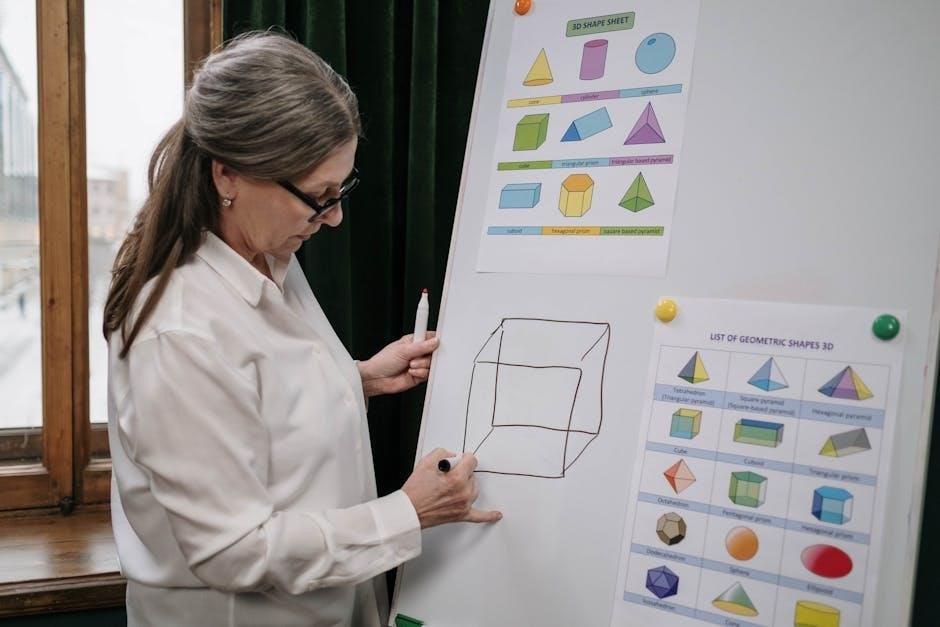
a transition to advanced mathematics pdf

Transitioning to advanced mathematics often requires dedicated study materials; PDFs offer a convenient, accessible format for exploring complex concepts and theorems.

What are Advanced Mathematics PDFs?
Advanced Mathematics PDFs are digital documents containing comprehensive materials designed for students and professionals delving into higher-level mathematical studies. These resources frequently encompass textbooks, lecture notes, problem sets with solutions, and research papers – all formatted for easy distribution and viewing. A “transition to advanced mathematics” PDF specifically targets students moving beyond introductory calculus and linear algebra.
These PDFs often bridge the gap between computational courses and the theoretical foundations required for proof-based mathematics. They typically cover topics like set theory, logic, mathematical induction, and rigorous definitions, preparing learners for abstract concepts. The portability and searchability of PDF format make them invaluable tools for self-study and academic pursuits.
Why Use PDFs for Advanced Math Study?
PDFs offer significant advantages for studying advanced mathematics, particularly when navigating a “transition to advanced mathematics” curriculum. Their accessibility across devices – computers, tablets, and smartphones – allows for learning anytime, anywhere. PDFs preserve formatting, ensuring equations and symbols display correctly, crucial for mathematical texts.
Furthermore, PDFs facilitate easy annotation; students can highlight key concepts, add notes directly onto pages, and bookmark important sections. Search functionality quickly locates specific theorems or definitions. Cost-effectiveness is another benefit, as many high-quality resources are available freely online. Finally, PDFs reduce paper consumption, promoting environmentally conscious study habits.
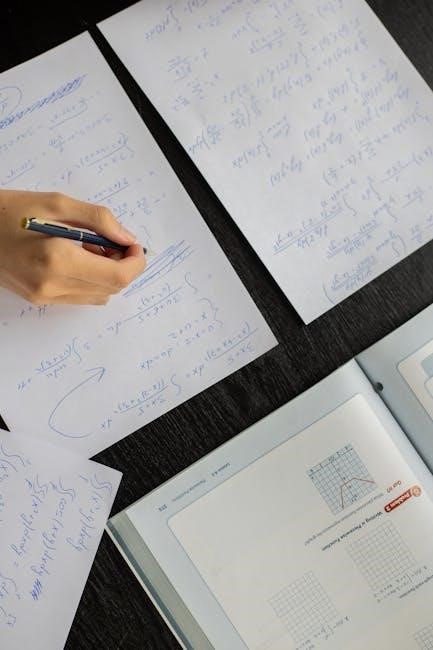
Core Concepts in Advanced Mathematics
Advanced mathematics builds upon foundational principles, demanding a firm grasp of calculus, linear algebra, and abstract algebra for successful progression.
Calculus: A Foundation
Calculus serves as the bedrock for much of advanced mathematical study, providing essential tools for analyzing change and motion. A solid understanding of limits, derivatives, and integrals is paramount when transitioning to more abstract concepts. PDFs dedicated to advanced calculus often delve into rigorous proofs and explore topics like multivariable calculus, sequences, and series. Mastery of these foundational elements unlocks comprehension in fields like differential equations and real analysis. Students utilizing PDFs should focus on not just memorizing formulas, but grasping the underlying principles and applying them to diverse problem-solving scenarios. Effective study involves working through numerous examples and actively engaging with the material, solidifying a robust calculus base for future mathematical endeavors.
Linear Algebra: Vectors and Matrices
Linear algebra is crucial for advanced mathematics, providing a framework for representing and manipulating data through vectors, matrices, and linear transformations. A strong grasp of concepts like vector spaces, eigenvalues, and eigenvectors is essential. PDFs focusing on this area often present abstract definitions and rigorous proofs, demanding a shift in thinking from computational to conceptual understanding. Students should prioritize mastering matrix operations, solving systems of linear equations, and understanding the geometric interpretations of linear transformations. Utilizing PDFs effectively requires consistent practice and a willingness to explore applications in diverse fields like computer science and physics, building a solid foundation for further study.
Abstract Algebra: Groups, Rings, and Fields
Abstract algebra introduces a higher level of mathematical abstraction, focusing on algebraic structures like groups, rings, and fields. PDFs in this area emphasize rigorous proofs and axiomatic systems, requiring students to develop strong logical reasoning skills. Understanding concepts like homomorphisms, isomorphisms, and quotient structures is paramount. A successful transition demands moving beyond concrete examples to embrace general properties and theorems. Students should actively engage with definitions, explore different algebraic structures, and practice constructing proofs. Utilizing supplementary resources alongside PDFs can solidify understanding and foster a deeper appreciation for the elegance of abstract algebraic thinking.

Finding Reliable Advanced Mathematics PDFs
Locating trustworthy PDFs requires careful sourcing; prioritize university websites, open educational repositories, and established mathematical archives for quality content.
University Course Materials
Many universities openly publish course materials, including lecture notes, problem sets, and even full textbooks, as PDFs. These resources, often designed for a “transition to advanced mathematics” course, provide a structured learning path and represent a high standard of academic rigor. Look for materials from reputable institutions known for their strong mathematics departments. Websites dedicated to specific courses, or the university’s open courseware initiative, are excellent starting points.
Be aware that the level of detail and completeness can vary. Some PDFs might be supplementary, while others form the core of the course. Always check the context and intended audience to ensure the material aligns with your current understanding and learning goals. These materials frequently offer a blend of theoretical explanations and practical examples, aiding comprehension.
Open Educational Resources (OER)
Open Educational Resources (OER) are freely accessible, openly licensed educational materials, including PDFs suitable for a “transition to advanced mathematics” study. These resources are often created by educators and institutions committed to making high-quality learning materials available to everyone. Platforms like MIT OpenCourseWare, Khan Academy, and OpenStax offer a wealth of mathematical content.
OER PDFs can range from complete textbooks to individual modules covering specific topics. They are a valuable alternative to traditional textbooks, often offering a more flexible and affordable learning experience. Always verify the license to understand how you can use, adapt, and share the material. Look for resources that align with established curricula and learning objectives.
Online Mathematics Archives

Online mathematics archives, such as the arXiv, provide preprints and published papers covering a vast range of mathematical topics, potentially including materials relevant to a “transition to advanced mathematics”. While often geared towards research-level mathematics, these archives can contain valuable supplementary materials or alternative explanations of core concepts.
However, be aware that materials on these archives may not undergo the same rigorous peer-review process as traditionally published textbooks. Carefully evaluate the author’s credentials and the mathematical rigor of the content. These archives are best used to supplement other learning resources, offering diverse perspectives and advanced topics.

Evaluating the Quality of Advanced Mathematics PDFs
Assessing PDFs for a “transition to advanced mathematics” requires scrutiny of the author’s expertise, publication details, and the clarity of mathematical explanations.
Author Credentials and Affiliations
When evaluating a PDF intended for a “transition to advanced mathematics,” the author’s background is paramount. Look for authors holding a doctorate in mathematics or a closely related field from a reputable university. Check for affiliations with established academic institutions – universities or research labs – which often indicate a level of peer review and scholarly rigor.
Consider their published works; a history of publications in respected mathematical journals suggests expertise. A simple online search can reveal an author’s academic profile and research interests. Be cautious of PDFs authored by individuals with unclear credentials or affiliations, as the content may lack the necessary depth and accuracy for advanced study. Prioritize materials from recognized experts in the specific mathematical area covered.
Publication Date and Relevance
For a “transition to advanced mathematics” PDF, the publication date significantly impacts its relevance. Mathematics evolves, and newer editions often incorporate updated theorems, proofs, and pedagogical approaches. While classic texts retain value, ensure the core concepts align with current mathematical standards.
A recently published PDF (within the last 5-10 years) is generally preferable, reflecting contemporary understanding. However, relevance isn’t solely about age. Consider if the material addresses the specific areas of advanced mathematics you’re studying. Check for references to current research or applications. Outdated PDFs may contain obsolete notation or approaches, hindering your learning process. Prioritize materials that remain current and applicable.
Mathematical Rigor and Accuracy
When evaluating a “transition to advanced mathematics” PDF, mathematical rigor and accuracy are paramount. Advanced mathematics demands precise definitions, logical proofs, and consistent notation. Scrutinize the PDF for clearly stated theorems, accompanied by complete and correct proofs.
Errors, even minor ones, can cascade and undermine understanding. Look for consistent use of mathematical symbols and terminology. A rigorous text will avoid hand-waving arguments and provide sufficient justification for each step. Cross-reference with established textbooks or resources to verify the presented material. Prioritize PDFs demonstrating a commitment to precision and logical consistency, ensuring a solid foundation for further study.

Utilizing Advanced Mathematics PDFs Effectively
For a “transition to advanced mathematics” PDF, actively engage with the material through problem-solving, annotation, and supplementing with external resources for deeper comprehension.
Annotation and Note-Taking
When studying a “transition to advanced mathematics” PDF, robust annotation and note-taking are crucial for solidifying understanding. Digital PDF readers allow highlighting key definitions, theorems, and examples directly within the text. Marginal notes should summarize complex proofs or pose clarifying questions.
Consider color-coding: one color for definitions, another for important results, and a third for areas needing further review. Don’t just passively highlight; actively paraphrase concepts in your own words. Create a separate notebook (physical or digital) to expand on these notes, working through additional examples and connecting ideas.
Effective note-taking transforms a passive reading experience into an active learning process, significantly improving retention and comprehension of challenging mathematical concepts.
Problem Solving Strategies
A “transition to advanced mathematics” PDF demands active problem-solving. Don’t simply read examples; attempt every exercise, starting with the simpler ones to build confidence. If stuck, revisit relevant definitions and theorems within the PDF.
Break down complex problems into smaller, manageable steps. Try working backwards from the desired result, or consider analogous problems you’ve already solved. Collaboration with peers can offer fresh perspectives, but always strive for independent understanding first.
Maintain a dedicated error log, analyzing mistakes to identify recurring weaknesses. Regular practice is paramount; consistent effort, even on challenging problems, fosters mathematical maturity.
Supplementing with Other Resources
While a “transition to advanced mathematics” PDF provides a core foundation, enriching your learning requires diverse resources. Explore online lecture series from reputable universities – MIT OpenCourseware and Khan Academy are excellent starting points. Seek out supplementary textbooks offering alternative explanations and problem sets.
Engage with online mathematical communities and forums to discuss challenging concepts and share solutions. Don’t hesitate to consult with professors or teaching assistants for clarification. Utilize mathematical software like Wolfram Alpha to verify calculations and visualize complex functions.
Remember, a multifaceted approach strengthens comprehension and fosters a deeper appreciation for the subject matter.

Advanced Topics Often Found in PDFs
Advanced PDFs frequently delve into real analysis, topology, and differential equations, building upon foundational concepts from a “transition” course.
Real Analysis: Rigorous Calculus
Real analysis represents a significant leap from introductory calculus, demanding a level of mathematical maturity often fostered by a “transition to advanced mathematics” course. PDFs dedicated to this subject meticulously examine the foundations of calculus – limits, continuity, differentiation, and integration – but with an emphasis on rigorous proofs and theoretical underpinnings. Expect detailed explorations of sequences and series, the completeness axiom, and uniform convergence.
These resources move beyond computational techniques to focus on why calculus works, not just how. Students will encounter epsilon-delta definitions and explore the subtleties of real numbers. PDFs often include challenging exercises designed to solidify understanding and prepare learners for more advanced mathematical disciplines. Mastering real analysis is crucial for further study in areas like functional analysis and partial differential equations.
Topology: The Study of Shapes and Spaces
Topology, often introduced after a “transition to advanced mathematics” course, diverges from traditional geometry by focusing on properties preserved under continuous deformations – stretching, bending, but not tearing or gluing. PDFs in this area explore concepts like open sets, closed sets, compactness, and connectedness, building a framework for understanding the fundamental nature of spaces.
Unlike geometry’s reliance on precise measurements, topology concerns itself with qualitative properties. Expect to encounter Hausdorff spaces, homeomorphisms, and the intricacies of quotient spaces. These resources demand abstract thinking and a strong grasp of set theory. PDFs frequently present challenging proofs and examples, fostering a deeper appreciation for the elegance and power of topological reasoning, essential for fields like data analysis and physics.
Differential Equations: Modeling Change
Differential equations, a cornerstone of applied mathematics often encountered after a “transition to advanced mathematics” course, provide a powerful language for describing dynamic systems. PDFs dedicated to this subject delve into ordinary differential equations (ODEs) and partial differential equations (PDEs), exploring techniques for finding solutions and analyzing their behavior.
Expect to encounter methods like separation of variables, integrating factors, and Laplace transforms. These resources emphasize modeling real-world phenomena – population growth, circuit analysis, heat transfer – using mathematical equations. PDFs frequently include examples and exercises, reinforcing understanding of concepts like stability, equilibrium, and chaotic behavior, crucial for engineering and scientific applications.

Tools for Working with Advanced Mathematics PDFs
Utilizing specialized PDF readers, alongside mathematical software, enhances the study experience; cloud synchronization ensures accessibility across devices for seamless learning.
PDF Readers and Editors
Selecting the right PDF reader is crucial when navigating advanced mathematical texts. Basic readers allow viewing and searching, but specialized editors unlock powerful features. Consider Adobe Acrobat Reader DC, offering annotation tools for highlighting key theorems and adding personalized notes directly onto the PDF pages.
For more advanced manipulation, explore PDF editors like PDFelement or Foxit PDF Editor. These allow for merging multiple documents, splitting large files, and even editing text – though caution is advised when altering mathematical formulas. Features like optical character recognition (OCR) can transform scanned pages into searchable text, a boon for older materials. Furthermore, some readers integrate directly with mathematical software, facilitating seamless equation editing and problem-solving workflows. Prioritize readers with robust search capabilities to quickly locate specific definitions or proofs within lengthy PDFs.
Mathematical Software Integration
Leveraging mathematical software alongside Advanced Mathematics PDFs significantly enhances the learning experience. Programs like Mathematica, Maple, and MATLAB can complement PDF study by allowing users to dynamically explore concepts presented in static form. Copying equations from a PDF into these tools enables verification, manipulation, and visualization – crucial for solidifying understanding.
Some PDF readers offer direct integration with these platforms, streamlining the workflow. Alternatively, utilizing OCR to convert PDF equations into editable formats facilitates import into mathematical software. This synergy is particularly valuable when dealing with complex calculations or proofs. Furthermore, software like LaTeX editors can be used to recreate and modify equations found within PDFs, fostering a deeper engagement with the material and promoting active learning.
Cloud Storage and Synchronization
Employing cloud storage solutions is paramount when working with extensive Advanced Mathematics PDFs. Services like Google Drive, Dropbox, and OneDrive provide secure, accessible repositories for these valuable resources, enabling study across multiple devices. Synchronization ensures that the latest version of a PDF is always available, preventing data loss and facilitating collaborative learning.
Cloud storage also simplifies sharing PDFs with peers or instructors. Version history features allow tracking changes and reverting to previous iterations if needed. Furthermore, cloud-based PDF editors enable annotation and note-taking directly within the browser, enhancing the interactive study experience. Backing up PDFs to the cloud safeguards against hardware failures and ensures long-term access to critical learning materials.